Slab Leaks in South Bay Homes: What They Look Like and How to Fix Them
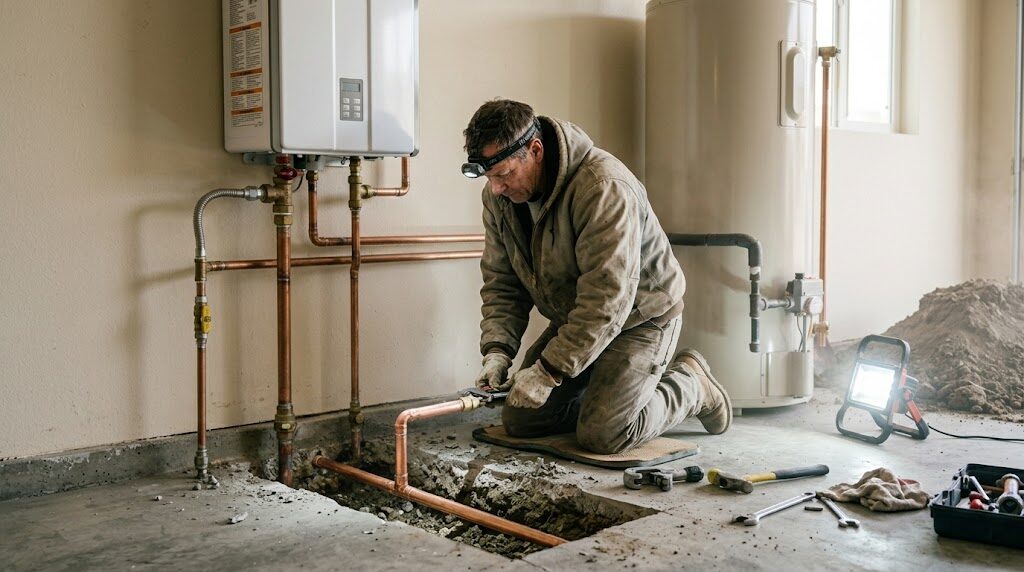
If you live in a slab-on-grade home anywhere from Torrance down to San Pedro, you're going to deal with a slab leak eventually. The water and sewer lines run inside the concrete foundation, and the copper down there has been quietly aging since the day the house was built. When it gives, the signs are quiet at first — and they're almost always the same.
The five signs we see on every slab-leak call
- One spot on the floor is warm — usually a hot-water line. Walk barefoot in the morning. The warm tile is the line.
- Your water bill jumped for no reason. A slab leak the size of a sewing-needle hole leaks 24/7 — easily 100+ gallons a day.
- The water meter dial spins with every fixture in the house turned off. Open the meter box at the curb, watch the small dial. If it's moving, water's going somewhere.
- You hear a faint hiss when the house is quiet. Pressed against the wall near the kitchen or bathroom, sometimes you can hear it.
- Mildew smell or staining at the base of a wall, especially in a hallway between the kitchen and bathroom — the path the water takes as it travels along the slab.
What actually causes them in our area
Three things, almost always:
- Aggressive soil. South Bay soil — especially closer to the coast in Hermosa, Manhattan and PV — has a salt content that eats copper from the outside in. Pre-1985 builds with thin-wall copper are the most exposed.
- Hot-water expansion fatigue. Hot lines flex more, and where the line bends to come up out of the slab, decades of expansion-contraction cycling cracks the copper at the elbow.
- Bad backfill. If gravel got dumped right against a copper run during the original pour, every micro-shift in the slab over 30 years rubs that line a little harder.
How we fix them
Three options — listed from least to most invasive:
1. Spot repair (jackhammer access)
We locate the leak with electronic listening gear or a tracer-gas probe, jackhammer a roughly 2'×2' patch over it, cut out the bad section, splice in new copper or PEX, and pour the patch back. The right call when it's a one-off failure and the rest of the slab lines look healthy on the camera scope.
2. Reroute the line
For a single hot-water run that's already shown one leak, sometimes it's smarter to abandon the slab line entirely and run a new line through the attic or a wall chase. We almost always recommend this if you're seeing a second leak within a few years of the first — repeat failures on the same line mean the whole copper run is fatigued.
3. Whole-house repipe
If the slab has 50+ years on it and you've had two slab leaks already, you're going to keep having them. A full repipe pulls all the supply lines into the walls and attic and abandons the slab entirely. It's a project — but it's the right call once the slab copper has shown a pattern. We'll walk you through every step before we start.
What to do tonight if you suspect one
Shut off the main water valve at the curb (the one with the rectangular nut, not the hose-bib at the house). Watch the meter for 30 minutes. If it doesn't move, the leak is on the house side — it'll wait until morning. If it does move, that's a service-side leak and the water company needs to know.
Either way, give us a call. We don't charge for the diagnostic visit on slab leaks within our service area.